
Russell Floersch, Elana Herzog, George McMahon at Catskill Art Space
Livingston Manor, NY — Catskill Art Space (CAS) is pleased to present a three-person exhibition featuring Russell Floersch, Elana Herzog, and George McMahon, on view from May 2 through June 20, 2026. The exhibition opens on Saturday, May 2, with an artists’ talk from 3–4 p.m. and a reception from 4–5 p.m. Working across painting, sculpture, and installation, the exhibition brings together three artists whose practices engage material, memory, and the physical experience of space in distinct yet resonant ways.
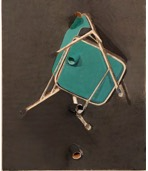 Russell Floersch’s paints at a modest scale, emphasizing a direct relationship between viewer and object. His canvases often incorporate loop-like relief elements derived from analog recording technologies, such as cassette tapes and film mechanisms, referencing the fragile processes of capturing and preserving memory. Themes of loss and degradation permeate the work, from cropped photographic imagery to the fading fidelity of sound. His recurring “broken chairs” motif are drawn from silent film, and introduce a subtle narrative of failure and absence, underscored by the conspicuous lack of sound.
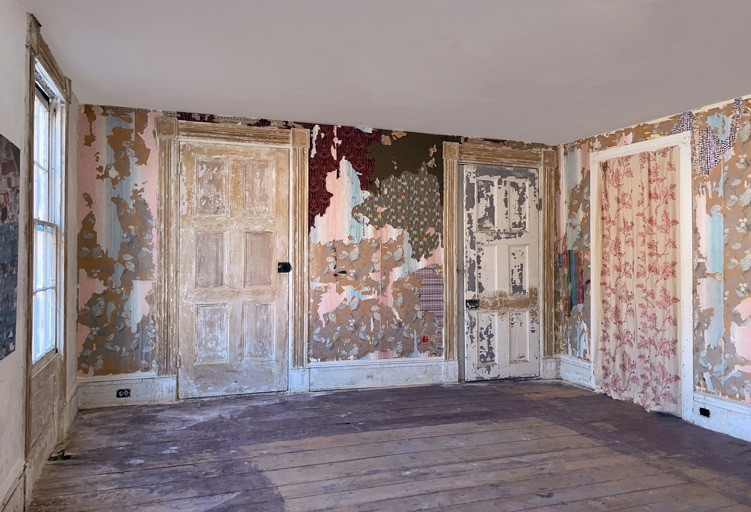 Elana Herzog engages material culture through the lens of textiles, using found fabrics to create labor-intensive, site-responsive installations and sculptural works. Her practice operates as a form of “domestic archaeology,” excavating histories embedded in cloth while exploring themes of migration, entropy, pleasure, and pain. Through accumulation and juxtaposition, Herzog reveals unexpected relationships between disparate materials and motifs, challenging hierarchies of taste and class. Her visually dense compositions transform architectural space, inviting multiple readings shaped by cultural memory and global exchange.
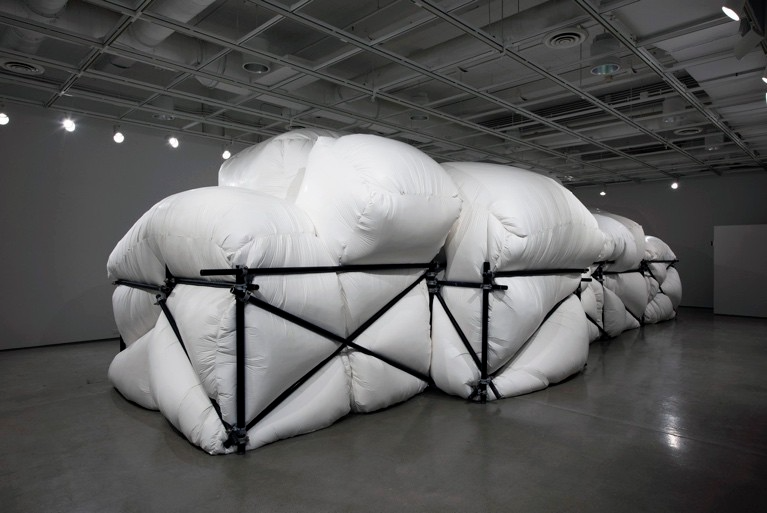 Ian McMahon creates large-scale, temporal installations that blur the boundaries between sculpture, architecture, and performance. Using theatrical and architectonic strategies, his works embed themselves within specific sites, transforming location into stage. Through intensive labor, material experimentation, and engineered construction, McMahon produces immersive environments that prioritize experience over permanence. His practice questions traditional notions of preservation, instead presenting transient encounters that evoke physical, sensory engagement and collective memory.
About the Artists
Russell Floersch received his MFA in Painting from the University at Buffalo in 1983 and was awarded a Fulbright Fellowship to West Berlin at the Universität der Künste. He has exhibited extensively since the 1980s, including at Civilian Warfare Gallery and Stux Gallery in New York. A recipient of a Pollock-Krasner Foundation Grant, Floersch has also taught at City College, CUNY, and Hastings College. He currently lives and works in Roxbury, NY.
Elana Herzog received her BA from Bennington College and MFA from Alfred University. Her recent survey at Koffler Arts in Toronto received critical attention from major publications. She has been awarded numerous honors, including a Guggenheim Fellowship, NYFA Fellowships, and grants from the Joan Mitchell Foundation and the Tiffany Foundation. Herzog has participated in residencies such as Yaddo, MacDowell, and the Joan Mitchell Center, among others. She lives and works in New York.
Ian McMahon received his MFA in Sculpture and Extended Media from Virginia Commonwealth University and his BFA in Ceramics from Alfred University. His work has been exhibited nationally and internationally at venues including DeCordova Sculpture Park and Museum and Suyama Space. He is the recipient of the Jacob K. Javits Fellowship and multiple NYSCA/NYFA Fellowships. McMahon is currently based in Newburgh, NY.
Long-term Installations
Following a major renovation and expansion, Catskill Art Space reopened in October 2022 with a long-term presentation of James Turrell’s Avaar (1982) in a custom-built gallery on the building’s second floor. A room-sized installation, Avaar is an important example of the artist’s early, wall-based “aperture” works, which function by creating two areas within a room. There is a “viewing space,” where one stands to see and experience the work, and a “sensing space,” which is an ambiguously defined area of diffused light. Avaar is one of the rare examples of Turrell’s aperture works to make use of white lighting only; no colors will be present in the installation. This work is in the collection of the Seattle Art Museum, which has granted CAS a special long-term loan to exhibit the work. The presentation at CAS marks the first time the work has been shown since the 1970s, giving audiences from the Catskills and beyond the rare opportunity to experience a major Turrell work that has not been seen in nearly five decades.
On the second floor’s central landing, Sol LeWitt’s vibrant Wall Drawing #992 unfolds in three sections, each consisting of 10,000 straight lines drawn in color marker, to create a mesmerizing arrangement of primary colors. On the fourth wall, presenting LeWitt’s Wall Drawing #991, straight, arced, and organic lines will encompass the wall in black marker and pencil. The conceptual, minimalist artist conceived guidelines for his two-dimensional works to be drawn directly on the wall. Much like Turrell’s Avaar, the LeWitt works were realized for CAS’s space; in this instance, they are generously loaned by the artist’s estate. This work was overseen by a draftsperson, who determines the length and placement of the lines, and executed by five artists local to the area over nearly two weeks.
The newly realized performance space on CAS’s second floor hosts British sculptor Francis Cape’s A Gathering of Utopian Benches—an installation of meticulous copies of benches built and used by communal societies. Cape’s installations have always argued that design and craft express belief. Utopian Benches, which has toured extensively throughout the US, was built from poplar grown near Cape’s studio in Narrowsburg, NY. To be considered both as contemporary sculpture as well as furniture that visitors can actively use, the benches reference the societies who first used them, inviting visitors to utilize them for exchange, discourse, and community. The installation, which is meant to be used by visitors both for contemplation and may be used for performance seating, overlooks an expansive wall of windows onto the Willowemoc Creek.
Ellen Brooks activates an intimate gallery space, framed by a partially open staircase, with Hang (2022), an installation suspending over 30 feet of scrolls of film negatives from the ceiling. The artist hangs transparencies and negatives in all formats and from clips attached to the ceiling, mimicking the practice of film photography. Hanging negatives reference the surrounding natural landscaping, evoking a cascading waterfall with coils of film collecting on the ground floor gallery.
About Catskill Art Space
Catskill Art Space (CAS) explores contemporary art practices of emerging and established artists. Through exhibitions, performances, classes, lectures, and screenings, CAS fosters creative community in the Catskills.
Established as Catskill Art Society in 1971, CAS reopened in October 2022 as Catskill Art Space following a major renovation and expansion of its multi-arts center, located in the picturesque hamlet of Livingston Manor in the Western Catskills. CAS presents a rotating slate of exhibitions, performances and other events featuring national and regional talents, alongside long-term installations of works by James Turrell, Sol LeWitt, Francis Cape, and Ellen Brooks. Learn more at catskillartspace.org.
Russell Floersch, Bent leg (green Samsonite), 2025-26, acrylic, modeling paste and graphite on canvas and paper tubes, 24 x 20 inches
Elana Herzog, Local Color, at Fahrenheit 451 House, Catskill, New York, 2021, Mixed textiles, existing wallpaper and other conditions, Dimensions Variable
Ian McMahon, Fugitive, 2016, Plaster, steel, hardware, 40' x 13' x 12'